Origin Bancorp, Inc. Reports Earnings for First Quarter 2026
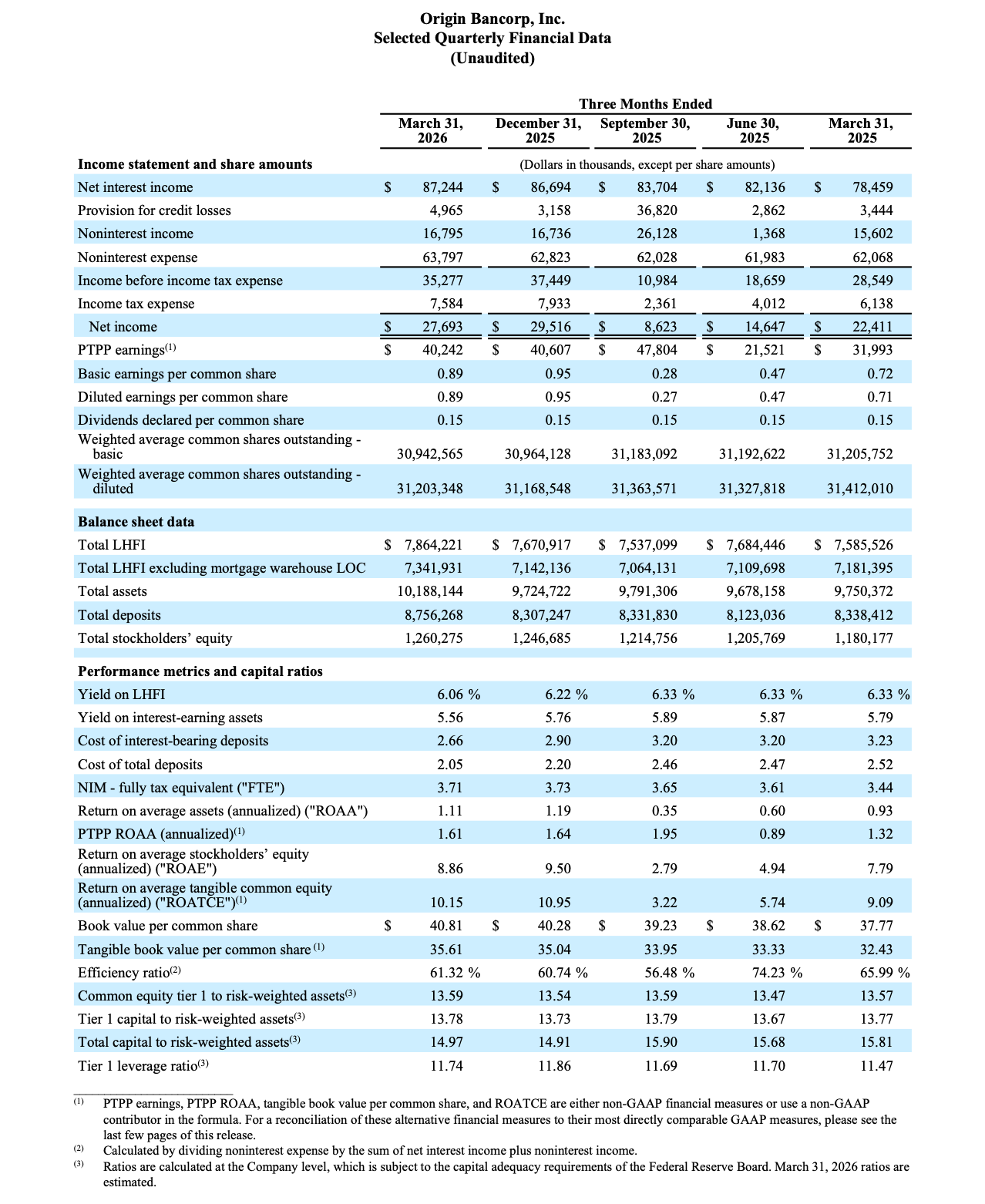
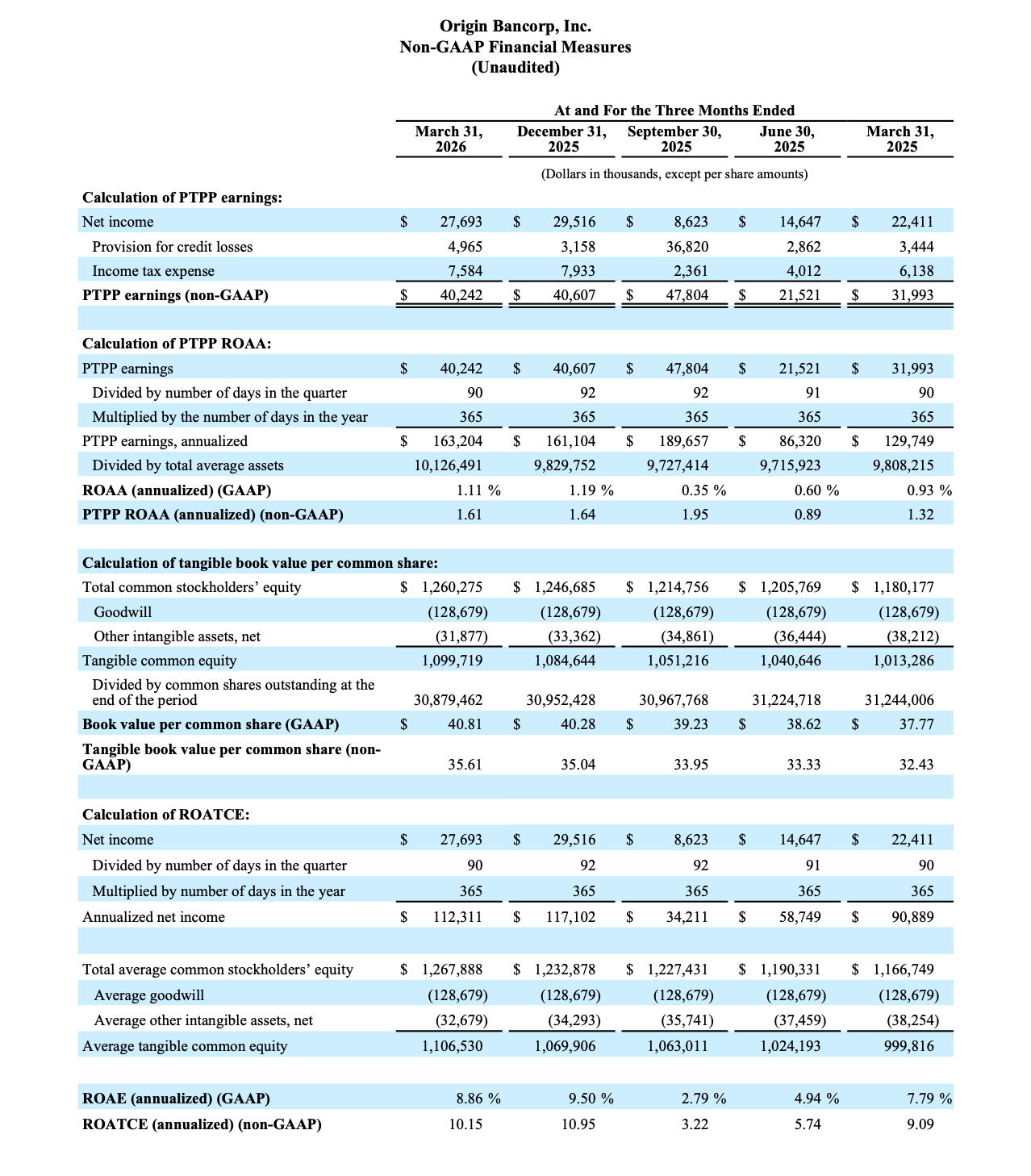
Origin Bancorp, Inc. (NYSE: OBK) (“Origin,” “we,” “our” or the “Company”), the holding company for Origin Bank (the “Bank”), today announced net income of $27.7 million, or $0.89 diluted earnings per share (“EPS”) for the quarter ended March 31, 2026, compared to net income of $29.5 million, or $0.95 diluted EPS, for the quarter ended December 31, 2025. Pre-tax, pre-provision (“PTPP”)(1) earnings were $40.2 million for the quarter ended March 31, 2026, compared to $40.6 million for the linked quarter.
“I am proud of our results this quarter and the strategic path that we are on as we continue to Optimize Origin in all that we do,” said Drake Mills, chairman, president and CEO of Origin Bancorp, Inc. “We have been deliberate in building a business that can deliver strong, long-term performance, and the first quarter is another example of that progress.”
(1) PTPP earnings is a non-GAAP financial measure, please see the last few pages of this document for a reconciliation of this alternative financial measure to its most directly comparable GAAP measure.
Optimize Origin
- In January 2025, we announced our Optimize Origin initiative to drive elite financial performance and enhance our award-winning culture, and it continues to be an important part of our corporate DNA.
- Built on three primary pillars:
- Productivity, Delivery & Efficiency
- Balance Sheet Optimization
- Culture & Employee Engagement
- As announced in our Fourth Quarter and Full Year 2025 Earnings Release, we updated our near term ROAA run rate target to 1.15% or higher by 4Q26, as we continue towards our ultimate target of a top quartile ROAA.
Financial Highlights
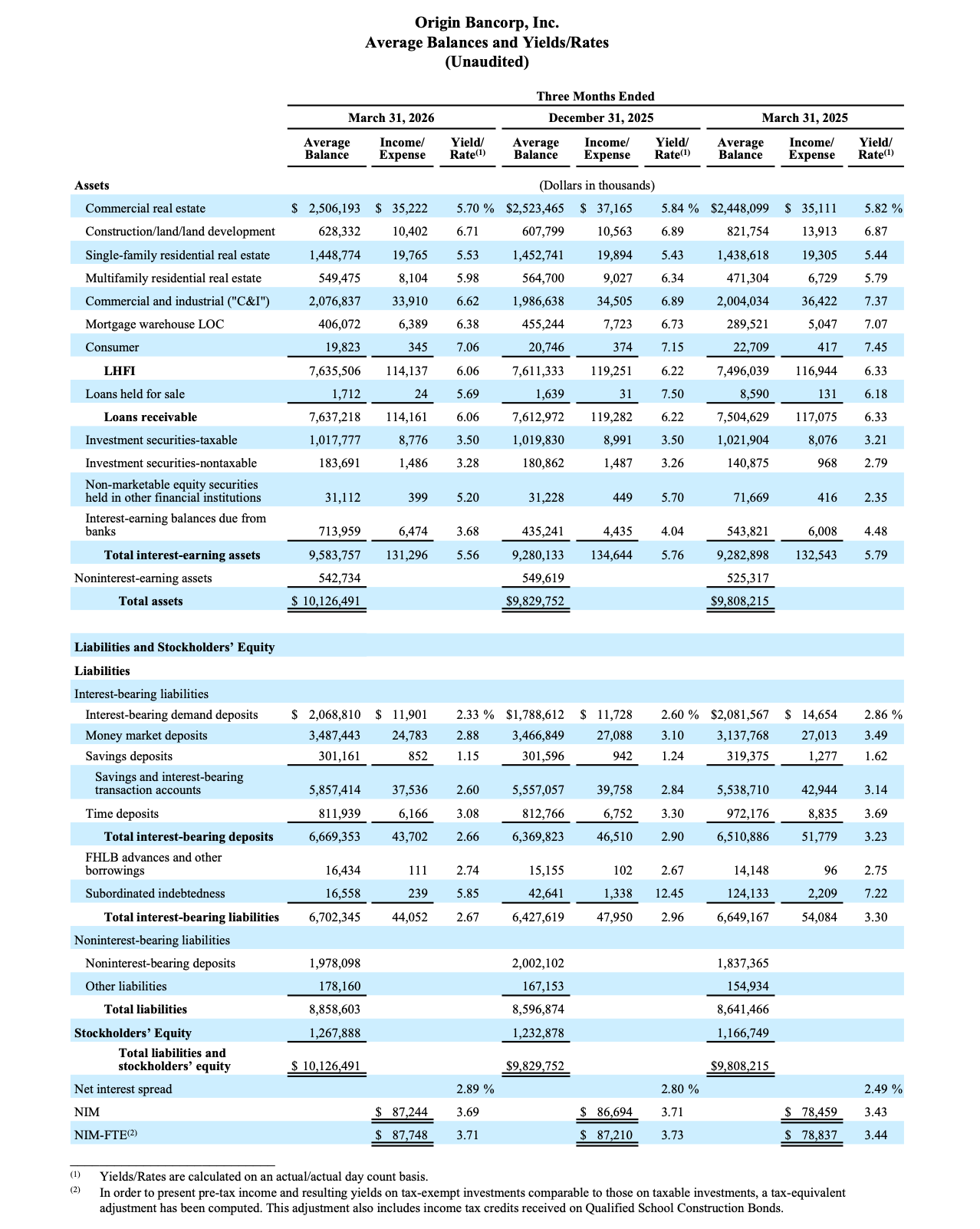
- Net interest income was $87.2 million for the quarter ended March 31, 2026, reflecting an increase of $550,000, or 0.6%, compared to the linked quarter and is at its highest level ever recorded.
- Our fully tax equivalent net interest margin (“NIM-FTE”) declined two basis points to 3.71% for the quarter ended March 31, 2026, compared to the quarter ended December 31, 2025. Our net interest spread increased to 2.89%, or nine basis points, compared to the linked quarter and is at its highest level since the quarter ended December 31, 2022.
- Annualized ROAA was 1.11% for the quarter ended March 31, 2026, reflecting a decrease of eight basis points, compared to the quarter ended December 31, 2025.
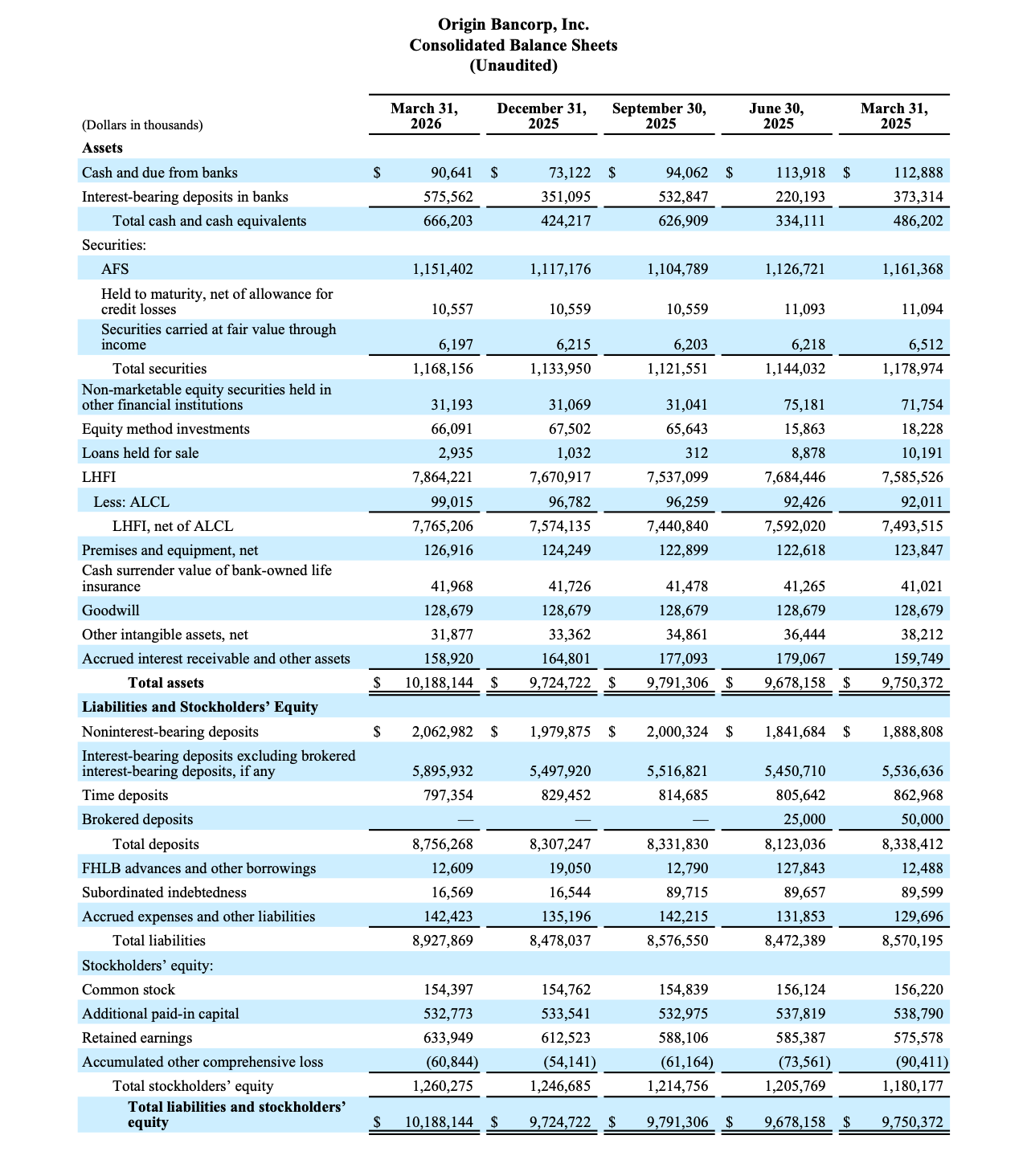
- Total loans held for investment (“LHFI”) were $7.86 billion at March 31, 2026, reflecting an increase of $193.3 million, or 2.5%, compared to December 31, 2025. LHFI, excluding mortgage warehouse lines of credit (“mortgage warehouse LOC”), were $7.34 billion at March 31, 2026, reflecting an increase of $199.8 million, or 2.8%, compared to December 31, 2025.
- Total deposits were $8.76 billion at March 31, 2026, reflecting an increase of $449.0 million, or 5.4%, compared to December 31, 2025, which includes an increase in interest-bearing deposits of $215.0 million that were repurchased on January 2, 2026, immediately following the sale of such deposits on December 31, 2025.
- During the quarter ended March 31, 2026, we repurchased 165,500 shares of our common stock at an average price of $41.27 per share, including commissions and applicable excise taxes.
- During April 2026, our board approved an increase in our quarterly dividend from $0.15 to $0.25 per share, a 67% increase, reflecting balance sheet strength and earnings durability.
Results of Operations for the Quarter Ended March 31, 2026
Net Interest Income and Net Interest Margin
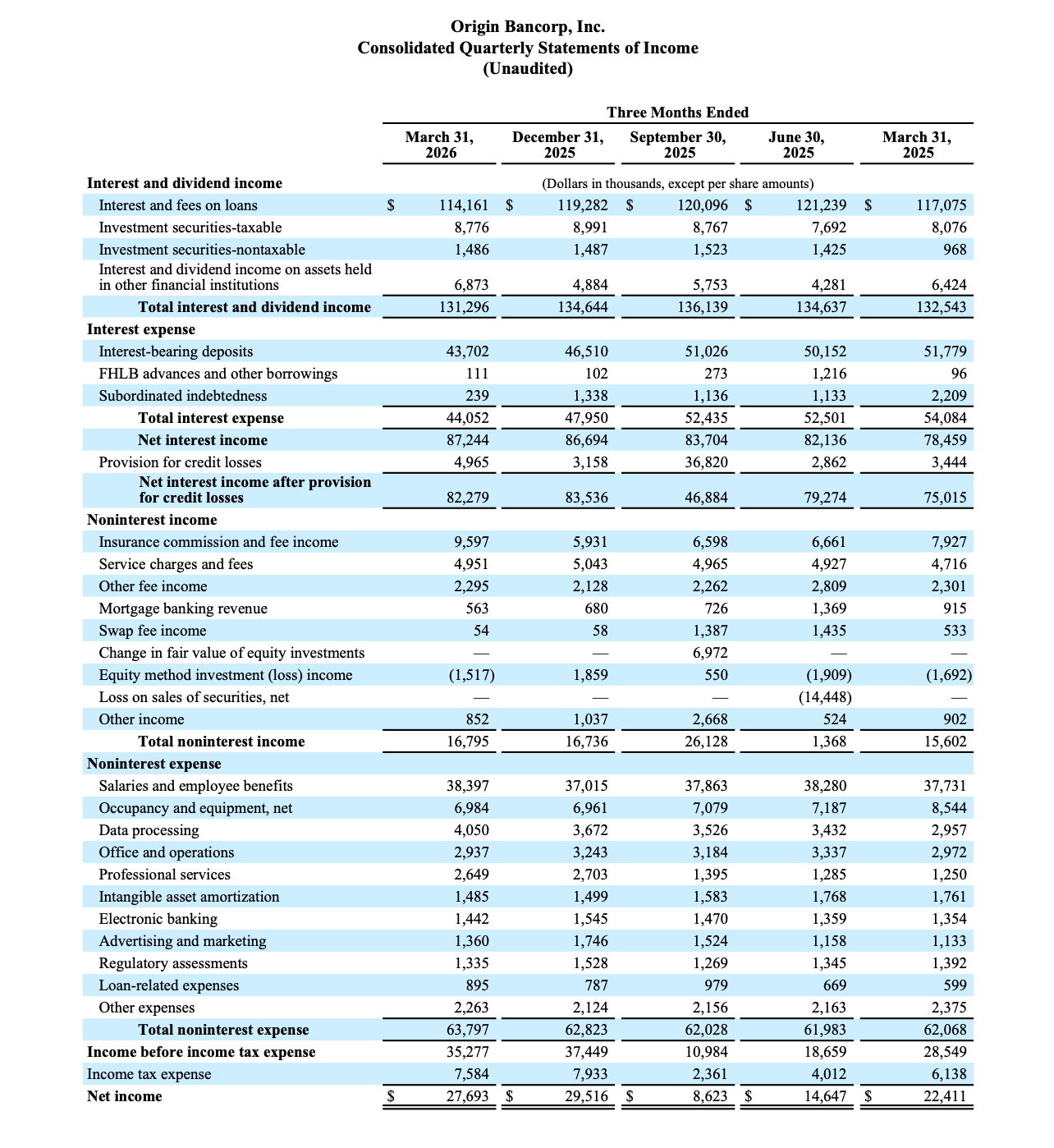
Net interest income for the quarter ended March 31, 2026, was $87.2 million, an increase of $550,000, or 0.6%, compared to the quarter ended December 31, 2025. The expansion in net interest income was primarily driven by a $3.9 million decrease in interest expense, mainly offset by a $3.3 million decrease in interest income.
The $3.9 million decrease in interest expense was mainly attributable to reductions of $2.3 million and $1.1 million in interest expense on money market deposit and subordinated debentures, respectively. The reduction in interest expense on money market deposits was primarily due to lower interest rates, as the average interest rate paid on money market deposits declined 22 basis points to 2.88%, from 3.10% for the quarter ended December 31, 2025. The lower interest expense on subordinated debentures was primarily attributable to the redemption of $74.0 million of subordinated debentures during the quarter ended December 31, 2025.
The $3.3 million decrease in interest income was primarily due to a $5.1 million decrease in interest income on loans held for investment, partially offset by a $2.0 million increase in interest income on interest-earning balances due from banks. The decrease in interest income on loans held for investment was mainly attributable to lower yields and two fewer calendar days, which reduced interest income by $3.1 million and $2.5 million, respectively, partially offset by higher average balances. Of the $3.1 million decrease in interest income attributable to lower yields, $1.4 million, $906,000 and $500,000 were attributable to commercial and industrial, commercial real estate, and multifamily residential real estate loans, respectively. Average balances in loans held for investment increased by $24.2 million to $7.64 billion, from $7.61 billion during the quarter ended December 31, 2025. The increase in interest income on interest-earning balances due from banks was primarily driven by higher average balances, which increased to $714.0 million, from $435.2 million for the quarter ended December 31, 2025, as deposit growth outpaced loan originations.
The Federal Reserve Board sets various benchmark rates, including the federal funds rate, and thereby influences the general market rates of interest, including loan and deposit rates offered by financial institutions. On October 29, 2025, and December 10, 2025, the Federal Reserve Board reduced the federal funds target rate range by 25 basis points each, to a range of 3.50% to 3.75%, and has maintained the federal funds target rate unchanged since December 10, 2025.
Our NIM-FTE was 3.71% for the quarter ended March 31, 2026, representing a two-basis point decrease and a 27- basis-point increase compared to the linked quarter and the quarter ended March 31, 2025, respectively. The two-basis point decrease was primarily due to a shift in earning-asset mix. The yield earned on interest-earning assets was 5.56%, representing decreases of 20- and 23-basis points compared to the linked quarter and the quarter ended March 31, 2025, respectively. The average rate paid on total interest-bearing liabilities was 2.67%, representing a reduction of 29- and 63-basis points compared to the linked quarter and the quarter ended March 31, 2025, respectively.
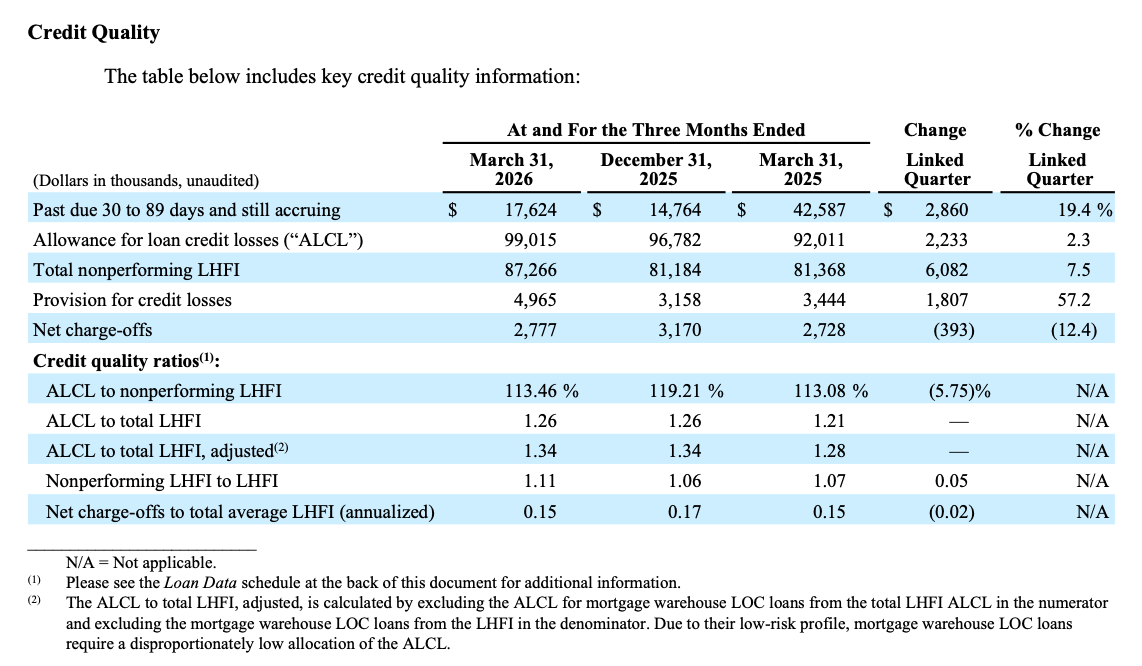
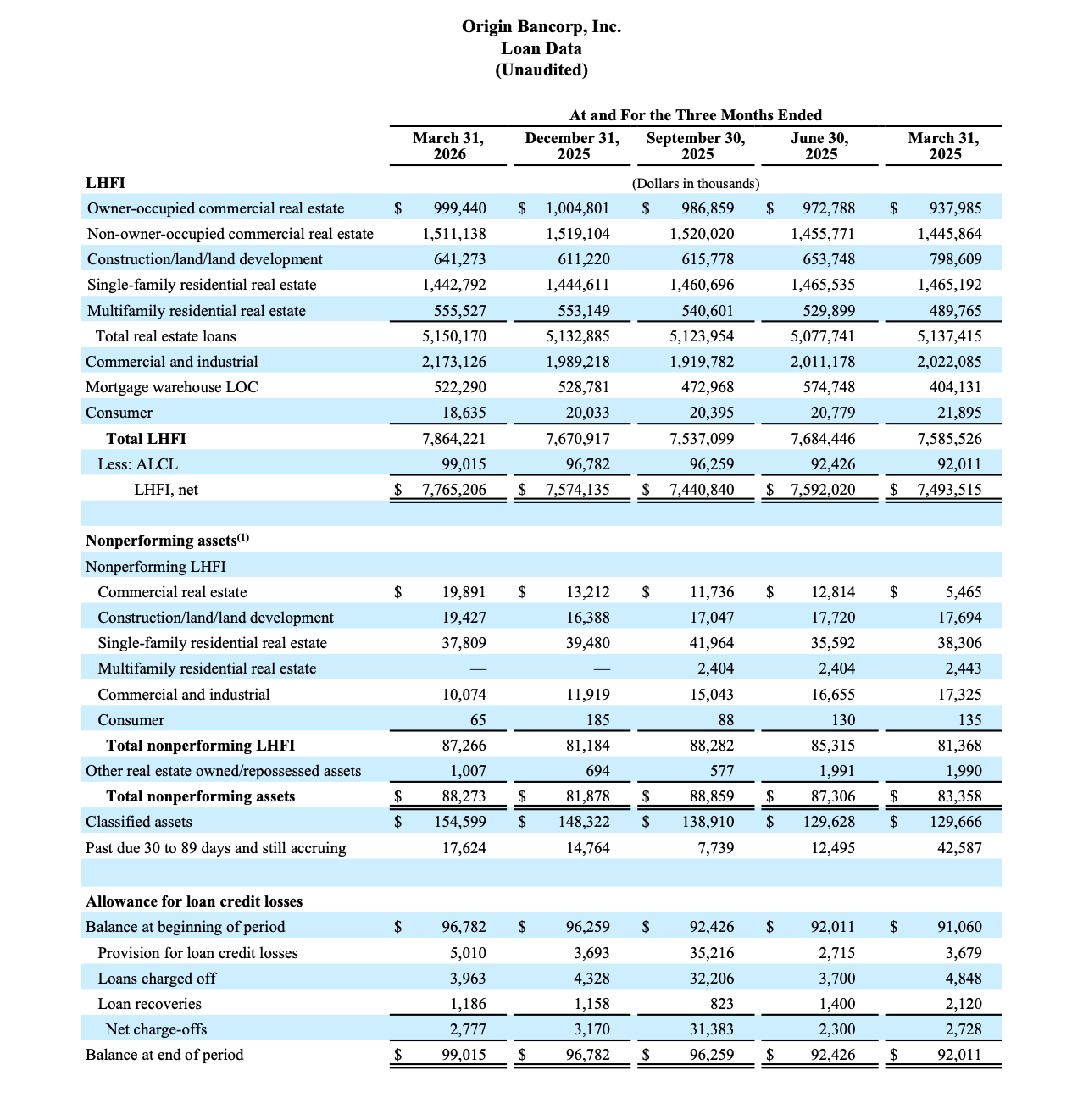
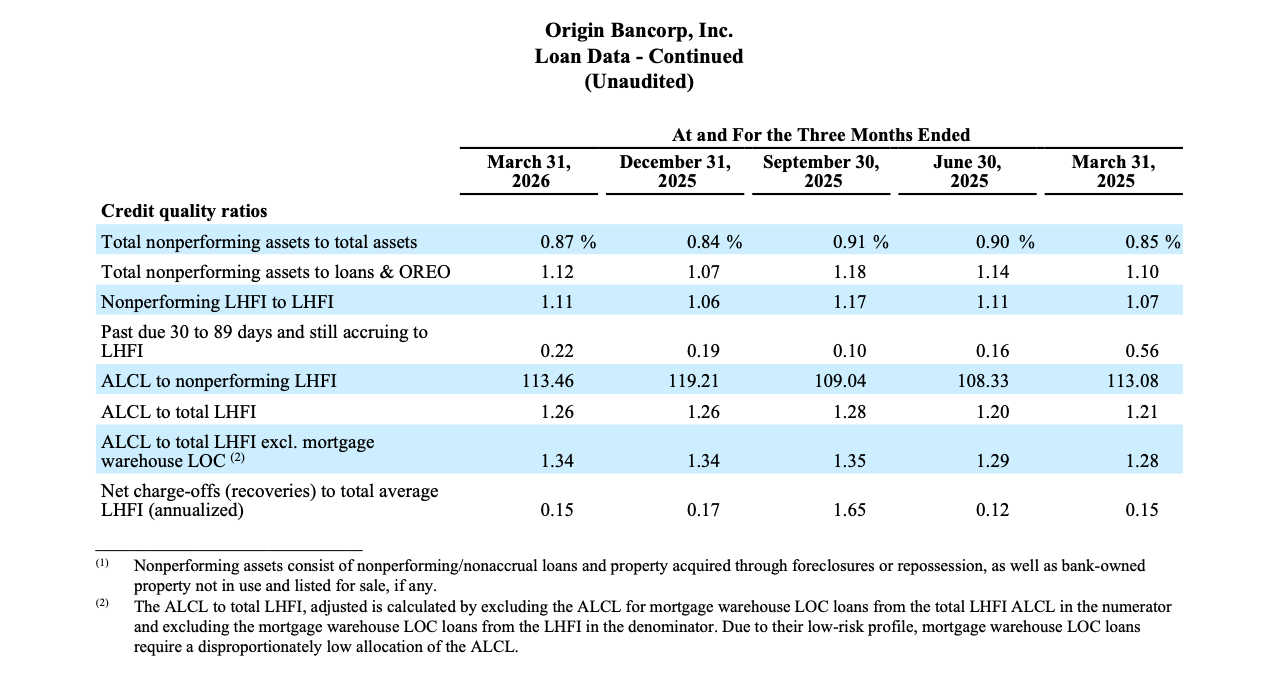
Our results included a provision for loan credit losses of $5.0 million during the quarter ended March 31, 2026, compared to $3.7 million for the linked quarter. The increase was primarily the result of portfolio migration during the quarter ended March 31, 2026. The ALCL totaled $99.0 million as of March 31, 2026, a $2.2 million increase compared to the ALCL as of December 31, 2025, and as a percent of total LHFI was unchanged.
Total nonperforming LHFI increased $6.1 million at March 31, 2026, when compared to December 31, 2025. The increase in nonperforming LHFI was driven by increases in the real estate secured sectors of commercial real estate and construction/land/land development offset by reductions in the sectors of single-family residential real estate and commercial and industrial.
Past due 30 to 89 days and still accruing increased $2.9 million at March 31, 2026, when compared to December 31, 2025 and represented 0.22% of total LHFI, compared to 0.19% as of December 31, 2025. The increase of 30 to 89 days and still accruing past dues was primarily driven by the increases of $1.8 million in the single-family residential real estate sector and increases of $1.2 million in each of the commercial and industrial and multifamily residential real estate sectors, offset by a $1.1 million reduction in the commercial real estate sector.
Noninterest Income
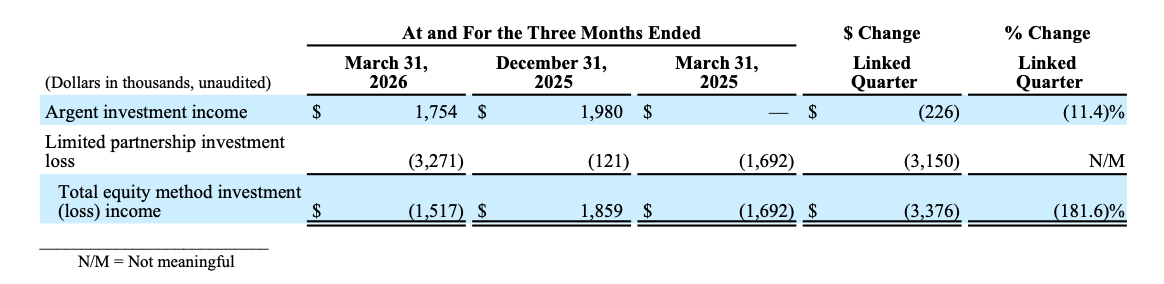
Noninterest income for the quarter ended March 31, 2026, was $16.8 million, an increase of $59,000 from the linked quarter, primarily driven by an increase of $3.7 million in insurance commission and fee income, which was largely offset by a decrease of $3.4 million in equity method investment (loss) income.
The $3.7 million increase in insurance commission and fee income was primarily driven by seasonality in annual renewals and annual contingency fee income recognized in the first quarter.
The $3.4 million decrease in equity method investment (loss) income was primarily driven by a $3.2 million downward adjustment in two limited partnership investments during the current quarter, compared to smaller adjustments recorded in the linked quarter.
The components of equity method investment income are as follows:
Noninterest Expense
Noninterest expense for the quarter ended March 31, 2026, was $63.8 million, an increase of $974,000, or 1.6% from the linked quarter. The increase was primarily due to an increase of $1.4 million in salaries and employee benefits expense.
The $1.4 million increase in salaries and employee benefits was driven by a $1.7 million increase in incentive compensation expense, including stock based incentive compensation in the current quarter.
Financial Condition
Loans
- Total LHFI at March 31, 2026, were $7.86 billion, an increase of $193.3 million, or 2.5%, from $7.67 billion at December 31, 2025, and an increase of $278.7 million, or 3.7%, compared to March 31, 2025.
- Excluding mortgage warehouse LOC, LHFI increased $199.8 million, or 2.8%, from December 31, 2025. The increase was primarily driven by increases of $183.9 million and $30.1 million in commercial and industrial loans and construction/land/land development loans, respectively.
Securities
- Total securities at March 31, 2026 were $1.17 billion, an increase of $34.2 million, or 3.0%, from $1.13 billion at December 31, 2025, and a decrease of $10.8 million, or 0.9%, compared to March 31, 2025.
- Accumulated other comprehensive loss, net of taxes, primarily associated with unrealized losses within the available for sale portfolio, was $60.8 million at March 31, 2026, an increase of $6.7 million, or 12.4%, from the linked quarter and a decrease of $29.6 million, or 32.7%, from March 31, 2025.
- The weighted average effective duration for the total securities portfolio was 4.14 years as of March 31, 2026, compared to 4.15 years as of December 31, 2025.
Deposits
- Total deposits at March 31, 2026, were $8.76 billion, an increase of $449.0 million, or 5.4%, compared to December 31, 2025, and an increase of $417.9 million, or 5.0%, from March 31, 2025. $215.0 million of the increase compared to the linked quarter is related to interest-bearing deposits that were repurchased on January 2, 2026, immediately following the sale of such deposits on December 31, 2025.
- At March 31, 2026, and December 31, 2025, noninterest-bearing deposits as a percentage of total deposits were 23.6% and 23.8%, respectively. At March 31, 2025, noninterest-bearing deposits as a percentage of total deposits were 22.7%.
Subordinate debentures
- Total subordinated debentures at March 31, 2026, were $16.6 million, a decrease of $73.0 million, or 81.5%, compared to March 31, 2025, due to the redemption of $74.0 million in subordinated debentures during the quarter ended December 31, 2025, in conjunction with our Optimize Origin initiative.
Capital
- Total capital at March 31, 2026, was $1.26 billion, an increase of $13.6 million, or 1.1%, compared to December 31, 2025, and an increase of $80.1 million, or 6.8%, from March 31, 2025.
- Uses of regulatory capital since the beginning of 2025 consist of the following:
- Repurchased 616,505 shares of our common stock at an average price of $36.72 per share, for a total of $22.6 million, including commissions and applicable excise taxes. There was $31.7 million remaining available for repurchases at March 31, 2026.
- Redeemed $143.6 million of subordinated debentures, including the amortization of the original issue discount and fair value mark.
- Declared $23.7 million in dividends to our stockholders.
Conference Call
Origin will hold a conference call to discuss its first quarter 2026 results on Thursday, April 23, 2026, at 8:00 a.m. Central Time (9:00 a.m. Eastern Time). To participate in the live conference call, please dial +1 (929) 272-1574 (U.S. Local / International 1); +1 (857) 999-3259 (U.S. Local / International 2); +1 (888) 700-7550 (U.S. Toll Free), enter Conference ID: 12997 and request to be joined into the Origin Bancorp, Inc. (OBK) call. A simultaneous audio-only webcast may be accessed via Origin’s website at www.origin.bank under the Investor Relations, News & Events, Events & Presentations link or directly by visiting https://dealroadshow.com/e/ORIGIN1Q26.
If you are unable to participate during the live webcast, the webcast will be archived on the Investor Relations section of Origin’s website at www.origin.bank, under Investor Relations, News & Events, Events & Presentations.
About Origin
Origin Bancorp, Inc. is a financial holding company headquartered in Ruston, Louisiana. Origin’s wholly owned bank subsidiary, Origin Bank, was founded in 1912 in Choudrant, Louisiana. Deeply rooted in Origin’s history is a culture committed to providing personalized relationship banking to businesses, municipalities, and personal clients to enrich the lives of the people in the communities it serves. Origin provides a broad range of financial services and currently operates more than 57 locations in Dallas/Fort Worth, East Texas, Houston, North Louisiana, Mississippi, South Alabama and the Florida Panhandle. In addition, Origin provides a broad range of insurance agency products and services through its wholly owned insurance agency subsidiary, Forth Insurance, LLC. For more information, visit www.origin.bank and www.forthinsurance.com.
Non-GAAP Financial Measures
Origin reports its results in accordance with generally accepted accounting principles in the United States of America ("GAAP"). However, management believes that certain supplemental non-GAAP financial measures may provide meaningful information to investors that is useful in understanding Origin's results of operations and underlying trends in its business. However, non-GAAP financial measures are supplemental and should be viewed in addition to, and not as an alternative for, Origin's reported results prepared in accordance with GAAP. The following are the non-GAAP measures used in this release: PTPP earnings, PTPP ROAA, tangible book value per common share, and ROATCE.
Please see the last few pages of this release for reconciliations of non-GAAP measures to the most directly comparable financial measures calculated in accordance with GAAP.
Forward-Looking Statements
This press release contains certain forward-looking statements within the meaning of the Private Securities Litigation Reform Act of 1995. Forward-looking statements include information regarding Origin Bancorp, Inc’s (“Origin”, “we”, “our” or the “Company”) future financial performance, business and growth strategies, projected plans and objectives, and any expected purchases of its outstanding common stock, and related transactions and other projections based on macroeconomic and industry trends, including changes to interest rates by the Federal Reserve and the resulting impact on Origin’s results of operations, estimated forbearance amounts and expectations regarding the Company’s liquidity, including in connection with advances obtained from the FHLB, which are all subject to change and may be inherently unreliable due to the multiple factors that impact broader economic and industry trends, and any such changes may be material. Such forward-looking statements are based on various facts and derived utilizing important assumptions and current expectations, estimates and projections about Origin and its subsidiaries, any of which may change over time and some of which may be beyond Origin’s control. Statements or statistics preceded by, followed by or that otherwise include the words “assumes,” “anticipates,” “believes,” “estimates,” “expects,” “foresees,” “intends,” “plans,” “projects,” and similar expressions or future or conditional verbs such as “could,” “may,” “might,” “should,” “will,” and “would” and variations of such terms are generally forward-looking in nature and not historical facts, although not all forward-looking statements include the foregoing words. Further, certain factors that could affect Origin’s future results and cause actual results to differ materially from those expressed in the forward-looking statements include, but are not limited to: (1) the impact of current and future economic conditions generally and in the financial services industry, nationally and within Origin’s primary market areas, including the impact of tariffs, as well as the financial stress on borrowers and changes to customer and client behavior as a result of the foregoing; (2) changes in benchmark interest rates and the resulting impacts on net interest income; (3) deterioration of Origin’s asset quality; (4) factors that can impact the performance of Origin’s loan portfolio, including real estate values and liquidity in Origin’s primary market areas; (5) the financial health of Origin’s commercial borrowers and the success of construction projects that Origin finances; (6) changes in the value of collateral securing Origin’s loans; (7) the impact of generative artificial intelligence; (8) Origin’s ability to anticipate interest rate changes and manage interest rate risk; (9) the impact of heightened regulatory requirements, reduced debit interchange and overdraft income and the possibility of facing related adverse business consequences if our total assets grow in excess of $10 billion as of December 31 of any calendar year; (10) the effectiveness of Origin’s risk management framework and quantitative models; (11) Origin’s inability to receive dividends from Origin Bank and to service debt, pay dividends to Origin’s common stockholders, repurchase Origin’s shares of common stock and satisfy obligations as they become due; (12) the impact of labor pressures; (13) changes in Origin’s operation or expansion strategy or Origin’s ability to prudently manage its growth and execute its strategy; (14) changes in management personnel; (15) Origin’s ability to maintain important customer relationships, reputation or otherwise avoid liquidity risks; (16) increasing costs as Origin grows deposits; (17) operational risks associated with Origin’s business; (18) significant turbulence or a disruption in the capital or financial markets and the effect of market disruption and interest rate volatility on our investment securities; (19) increased competition in the financial services industry, particularly from regional and national institutions, as well as from fintech companies; (20) compliance with governmental and regulatory requirements and changes in laws, rules, regulations, interpretations or policies relating to financial institutions; (21) periodic changes to the extensive body of accounting rules and best practices; (22) further government intervention in the U.S. financial system; (23) a deterioration of the credit rating for U.S. long-term sovereign debt; (24) Origin’s ability to comply with applicable capital and liquidity requirements, including its ability to generate liquidity internally or raise capital on favorable terms, including continued access to the debt and equity capital markets; (25) natural disasters and other adverse weather events, pandemics, acts of terrorism, war, and other matters beyond Origin’s control; (26) developments in our mortgage banking business, including loan modifications, general demand, and the effects of judicial or regulatory requirements or guidance; (27) fraud or misconduct by internal or external actors (including Origin employees); (28) cybersecurity threats or security breaches and the cost of defending against them; (29) Origin’s ability to maintain adequate internal controls over financial and non-financial reporting; and (30) potential claims, damages, penalties, fines, costs and reputational damage resulting from pending or future litigation, regulatory proceedings and enforcement actions. For a discussion of these and other risks that may cause actual results to differ from expectations, please refer to the sections titled “Cautionary Note Regarding Forward-Looking Statements” and “Risk Factors” in Origin’s most recent and future Annual Reports on Form 10-K filed with the Securities and Exchange Commission and any updates to those sections set forth in Origin’s subsequent Quarterly Reports on Form 10-Q and Current Reports on Form 8-K. If one or more events related to these or other risks or uncertainties materialize, or if Origin’s underlying assumptions prove to be incorrect, actual results may differ materially from what Origin anticipates. Accordingly, you should not place undue reliance on any forward-looking statements. Any forward-looking statement speaks only as of the date on which it is made, and Origin does not undertake any obligation to publicly update or review any forward-looking statement, whether as a result of new information, future developments or otherwise.
New risks and uncertainties arise from time to time, and it is not possible for Origin to predict those events or how they may affect Origin. In addition, Origin cannot assess the impact of each factor on Origin’s business or the extent to which any factor, or combination of factors, may cause actual results to differ materially from those contained in any forward-looking statements. All forward-looking statements, expressed or implied, included in this communication are expressly qualified in their entirety by this cautionary statement. This cautionary statement should also be considered in connection with any subsequent written or oral forward-looking statements that Origin or persons acting on Origin’s behalf may issue. Annualized, pro forma, adjusted, projected, and estimated numbers are used for illustrative purposes only, are not forecasts, and may not reflect actual results.
This press release contains projected financial information with respect to Origin, including with respect to certain goals and strategic initiatives of Origin and the anticipated benefits thereof. This projected financial information constitutes forward-looking information and is for illustrative purposes only and should not be relied upon as necessarily being indicative of future results. The assumptions and estimates underlying such projected financial information are inherently uncertain and are subject to significant business, economic (including interest rate), competitive, and other risks and uncertainties. Actual results may differ materially from the results contemplated by the projected financial information contained herein and the inclusion of such projected financial information in this release should not be regarded as a representation by any person that such actions will be taken or accomplished or that the results reflected in such projected financial information with respect thereto will be achieved.
Contact:
Investor Relations
Chris Reigelman, 318-497-3177, chris@origin.bank
Media Contact
Ryan Kilpatrick, 318-232-7472, rkilpatrick@origin.bank